The Eye Exit

Stuff like this is fascinating, but it gives me a bit of a tight feeling in my innards:

When Liane Lefever complained to her doctor about a persistent ear ache, an examination found a much more serious problem: a brain tumor.

For many Americans, that diagnosis could have led to invasive surgery — including slicing open her skull — and a long recovery. But with an innovative procedure being pioneered by two doctors from Johns Hopkins Hospital, her tumor was removed through a small incision in her eyelid.

[…]

When the doctors told her they would enter the brain through her eyelid, she was most worried about her vision. But the procedure poses little threat of that, though she did lose some of her sense of smell because of the tumor’s location. She was wearing contacts again in three months and back at work at the family french fry business in several weeks.

[…]

Under the minicraniotomy, the eyelid is cut at a crease, and a quarter-sized piece of bone is removed just above the eyebrow. A computer-guided endoscope fitted with a camera leads surgical instruments to a tumor or a brain fluid leak needing repair. Once the work is done a few hours later, the bone is replaced and a small metal plate is used to hold it in place. A few dissolvable sutures close the eye lid and leave no visible scar.

Source: Doctors perform brain surgery via eyelid

Amazing!

And there’s even a life lesson or two here.

Here’s one: You can get to my brain through my eye. What am I allowing in?
The Fly in Your Ointment

With a title like that, I don’t mean to make light of this:

“Because David did that which was right
in the eyes of the LORD,
and turned not aside from
any thing that he commanded him
all the days of his life,
save only in the matter of
Uriah the Hittite.”
1 Kings 15:5

David repented.

God forgave.

But the record remained.

I’m grateful for forgiveness.

And cleansing.

So I can enjoy the ointment again.

(Does any of this make sense to you?)

Curiosity in Chess

So Monday evening Andrew wondered if I wanted to play a game of chess.

I did.

But we didn’t get to finish that evening.

After my nap the next morning, I told him we should finish before our visitors arrived. (He was in an excellent position to win and I didn’t want someone knocking over the board.)

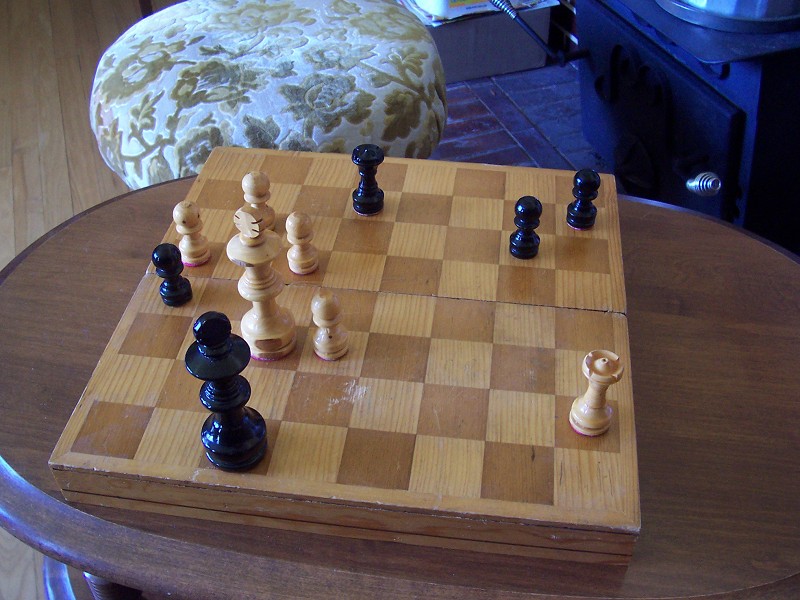
Eventually I (playing black) worked my way into this winning position:

chess game image 1
Should I capture the pawn with my black rook?

I was quite certain I could win if I made my move be rook captures pawn.

Then I wondered, “What will Andy do if I advance my pawn instead?” So I did.

Read it all

Winning People

Alternate title: How to Avoid Being Avoidable

I’ve been thinking for a while about how some people have a “knack” for alienating others. Or if not alienating them, at least building walls or burning bridges between them.

So if you’re one of those, here are some things you — yes, you — should avoid in order to not flunk the “Winning People” part of real living:

  1. Be critical of them or how they do (or don’t do) stuff.
  2. Have a scornful or demeaning attitude toward them, even for “justifiable” reasons. 😯
  3. Downplay their accomplishments or sufferings by raising up your “superior” ones. πŸ™„
  4. Call attention to your accomplishments or your insights.
  5. Make the conversation (if not the prospective relationship) primarily about you.
  6. Hold them to your personal standards of whatever…and make sure they know it.
  7. Pooh-pooh their personal standards and likes and preferences if you fail to meet them.
  8. Be controlling of (and unjust with) those clearly under your authority.
  9. Be demanding. (Hint: This is made worse when you have no “right” to be demanding.)
  10. Be an ingrate.
  11. Be impatient.
  12. Be thin-skinned about criticism or less-than-complimentary input.
  13. Be rhino-hided about criticism or less-than-complimentary input.
  14. Be hyper-sensitive and imaginative (and then unduly inquisitive) about what other people say, do, think, imagine, and mean.
  15. Have a Bah Humbug attitude toward this subject and this list. (No, really!)
  16. Be disrespectful.
  17. Fuss at and criticize and argue with your spouse in public…or in front of them.
  18. Don’t apologize when you’re wrong or when you’ve wronged others. Instead make excuses. Or blame others.
  19. Take a list like this…and put people on the spot with it (or with this subject as a whole).
  20. Imagine I’m targeting this at you specifically. (Do you really think I’d be so careless or class-less? Especially in a wide-open public forum like this? Give me a break!) πŸ˜€ Also see #5. πŸ˜†

Is there more that should be said on so needful a subject?

Yup, I’m afraid so.

That’s what the Comments section below is about! πŸ™‚

So if you want people to be around you or if you want people to look forward to being around you….listen up!

For all that I know (and for all that you know), some people treat being around you as something that must be done in order to “get it over with.”

Do you like being that kind of person?

Just askin’.

πŸ˜‰

PS: If you’re a Christian, this subject becomes even more important.

Surrounded

You are my hiding place;
You shall preserve me from trouble;
You shall surround me with songs of deliverance.

Psalm 32:7 (NKJV)

I read Psalm 32 this morning before reading this (which is why I chose to read Psalm 32):

Flying into a storm is a dangerous experience. The temptation is to fly by your instincts, or, as aviators say, β€œby the seat of your pants.” But as any pilot will tell you, that’s a prescription for disaster. If you rely on your feelings and instincts, you become disoriented….

We all face storms that threaten to confuse and disorient us. […] When you are blinded by life’s disappointments, don’t trust your instincts. Flying by the seat of your pants in the storms of life can lead to despair, confusion, and vengeful responses that make matters worse.

Read the rest: Instincts

I need that. Do you?

Private
Above all, love God!