Create a big smile or produce a sad frown;
So in all your contacts with people each day,
Be sure to encourage in all that you say.
—Fitzhugh
HT: Our Daily Bread
Mark's Views, Perhaps — from behind my eyeballs
HT: Our Daily Bread
It is very difficult to hate babies.
It takes a special person.
[…]
But the human being does have to learn to hate children and babies, and to regard the torture and murder of them as morally desirable acts. It takes years of work to undo normal protective human attitudes toward children.
That is precisely what the Nazis did and what significant parts of the Muslim world have done to the word “Jew.”
[…]
Yet, when Pakistan was yanked from India and established as a Muslim state at the very same time Israel was established, that act engendered 12.5 million Muslim refugees and about a million dead Muslims (and similar numbers of Hindu refugees and deaths). Why then doesn’t “Hindu” equal “Jew” in the Muslim lexicon of hate?
Here are some answers in brief:
You can read the full article here: The Other Tsunami.
Know this, though: Matters will get worse. Much worse. And it will seem even more normal. And nothing by which to get unduly exercised. As has abortion. Which also takes “a special person” to perform, accept, tolerate, and/or ignore.

Christians, don’t forget this: Americans, Arabs, Hindus, Japanese, Jews — we all need Jesus to the exact same degree.
“Count it all joy, my brothers, when you meet trials of various kinds . . .” (James 1:2).
Have you ever met a person who actually, literally did what this verse says? I have. Marilyn (not her real name) phoned and told me that her husband has been diagnosed with prostate cancer, her son is recovering from multiple stab wounds inflicted by a crazed stranger in Center City, and her daughter-in-law is so weakened by some bizarre condition that she is unable to hold her newborn. And she was radiating joy.
Marilyn figured that God must be really up to something! He must be really shaking things up for a good purpose for all this to be coming down at once. This, she reasoned, must be nothing other than the “testing of faith” of verse 3 that issues in a new level of “steadfastness,” whose “full effect” makes “perfect and complete” (verse 4). Marilyn wants that “perfect and complete” thing, for herself and for her family. She wants it more than she wants their or her health.
[…]
I know that Marilyn’s counting all of her inherently difficult circumstances as joy is accompanied by a fair amount of muscular thinking and believing. Her logic seems to be this: God is love; He sends trial to build faith; He will reward tenacious faith with something wonderful that no eye can see nor ear can hear nor the heart of man can conceive. Immediately, that understanding of Marilyn’s yields a quiet hope and a joy. It turns out that God really does keep at perfect peace the heart that is steadfast, because it trusts in Him (Isaiah 26:3). Who’d have thought it?
I accept that.
To such an extent that I want to live it.
But I haven’t enjoyed the pain in the process.
PS: Be sure to read the whole piece; I left out several paragraphs: Counting all difficulties as joy.
As is my wont, last night before going to bed I read the day’s portions from Daily Light on the Daily Path. Here’s the morning’s section:
The fruit of the Spirit is love.
God is love: and he that dwelleth in love dwelleth in God, and God in him. — The love of God is shed abroad in our hearts by the Holy Ghost which is given unto us. — Unto you … which believe he is precious. — We love him, because he first loved us. — The love of Christ constraineth us; because we thus judge, that if one died for all, then were all dead: and that he died for all, that they which live should not henceforth live unto themselves, but unto him which died for them, and rose again.
Ye yourselves are taught of God to love one another. — This is my com-mandment, That ye love one another, as I have loved you. — Above all things have fervent charity among yourselves: for charity shall cover the multitude of sins. — Walk in love, as Christ also hath loved us, and hath given himself for us, an offering and a sacrifice to God for a sweet-smelling savour.
GAL. 5:22. I John 4:16. -Rom. 5:5. -I Pet. 2:7. -I John 4:19. -II Cor. 5:14,15. I Thes. 4:9. -John 15:12. -I Pet. 4:8. -Eph. 5:2.
I got to thinking, “How do I try to avoid obeying the divine command to love? Do I figure there are other verses that somehow free me from obedience to this command? For instance, do I ever think that the imperative to confront error and sin somehow minimizes the overarching requirement to love?”
Let me ever remember this: All other commands hang from the twin commands to love.
It does not work the other way.
So let me love — first, foremost, last, in between, always.
Dropping that, I have nothing left upon which to securely hang any other obedience.
Period.
(You can read the evening’s section here as well: Daily Light on the Daily Path – March 1.)
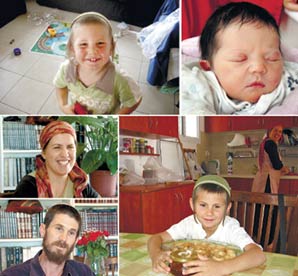
Jeff and Carolyn led the way.
“As a Christian, I realize that forgiveness is the only way I can be a Christian.” said Jeff. “And in return for that, forgiveness is required of me. So, in that sense, I don’t have a choice.”
They implored us all to forgive a man named Clifford Helm. He was driving the other truck that November night. Original theories ranged from cell-phone distraction to a suicide mission. In court, Helm’s lawyers told the jury he had a coughing fit and blacked out. Before their children were even buried, Carolyn and Jeff visited Helm in the hospital. And, when he was found not guilty of vehicular homicide, the Schrocks stood by his side.
“We personally believe that Cliff was just as much a victim in all this as we were. It was outside of his control,” explained Jeff.
Five years later, that bond remains strong. The two families have dinners together and say their friendship is both strong and necessary for their healing. How do they do it? The Schrocks say – simply – faith.
“As a human, it’s hard to understand that,” said Jeff. “It’s the way we believe God has designed it.”
Please, read the rest: Grace in Grief: The Schrock Family, Five Years Later.
The 2010 World Cup in South Africa generated over 3 million visitors from across the globe to join in weeks of festivities. The next World Cup is not until 2014, but with those kinds of numbers, host country Brazil has already begun to prepare.
[…]
One of the largest threats to the impoverished of the country as it relates to the events is a swell in human trafficking. A rise in the number of sex slaves is inevitably tied to these large sporting events, as was evidenced at the 2010 World Cup in South Africa and the 2010 Olympic Games in Vancouver, Canada. Where the demand is high, so also will be the supply.
The “supply” in Brazil is already disturbingly high and will only grow. Kathy Redmond with Compassion International describes the current scene as “pure evil.”
[…]
Young Brazilian girls are sold, coerced or abducted into the sex trade, blossoming numbers of victims to as many as 400,000, according to the U.S. State Department.
[…]
An International Mission Board worker told Mission Network News that traffickers “started the trafficking of people in 2004 as soon as they found out the World Cup would be in South Africa” for 2010. […] With just three years to go until the next games, young girls and boys may already be getting trafficked and prepped.
Source: Traffickers likely already preparing for next World Cup
Paul admitted to being “perplexed but not in despair” (2 Corinthians 4:8). I am curious about what could perplex a mature believer like Paul to the extent that despair was in the ballpark of contemplatable reactions. He doesn’t go into detail, so we must imagine.
[…]
I would suspect that what perplexed Paul was what has perplexed God’s people of all time—God seeming to act inconsistently with his promises or character. One psalmist asked God: “Why, O LORD, do you stand afar off? Why do you hide yourself in times of trouble?” (Psalm 10:1). That’s my perplexity too. Recently I prayed according to Hebrews 6:11 for “grace to help in time of need”—and I felt no different afterward, no abating of symptoms.
There are two different choices you can make at that point. You can be perplexed in doubt, or you can be perplexed in faith. Francis Schaeffer had said that there are at all times only the two “chairs” in the room: unfaith and faith.
[…]
Here is the other way to be perplexed when your soul is in distress. The first part of the sentence may be the same:
“Lord, I’m perplexed. I came to the throne like You said [but at this point it takes a different turn] and I didn’t feel any differently after I prayed, nor any abating of my distress. I am tempted to think You didn’t hear me. But I will not go there. I know that You require faith. You said in your Word that if anyone would come to You he must believe that You exist and that You reward the one who earnestly seeks You (Hebrews 11:6). So I will believe that You heard me. I believe that as soon as I asked for help, You heard me and You are working something out. I will put my trust in You. Help me to be perplexed without unbelief.”
Really, you would do well to read the whole piece: How to be perplexed.